> For the complete documentation index, see [llms.txt](https://help.rechat.com/llms.txt). Markdown versions of documentation pages are available by appending `.md` to page URLs; this page is available as [Markdown](https://help.rechat.com/appendix/brokerage-set-up/marketing-template-guidelines/figma/placeholders.md).
# Placeholders
When agents use a template, they want it to automatically populate their personal and listing data. This is where placeholders come in.
We are going to pull up a designed Listing template in Figma:
There is information on this template that needs to be connected to the user's account:
* The listing Photo
* The website on left
* The phone number
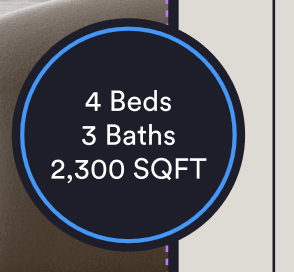
* Number of beds, baths and square footage
## Image Placeholders
Let's start by connecting the listing image.
1. Open up the Rechat plugin
2. Select your photo by double-clicking on it
3. Navigate to the placeholders tab where you'll see this:\

4. Click on *Listing Placeholders*
5. Click on *Listing Photo*
This tells Rechat that this picture should be replaced with the listing's picture when agents open the template.
{% hint style="warning" %}
Note that shapes or SVGs cannot be placeholderized.
{% endhint %}
Note that you can use the similar method to input Brokerage Logo, Team Logo or Agent Placeholders.
## Text Placeholders
Next, placeholderize the text.
1. Select a piece of text in Figma by double clicking on it.
2. Open up the Rechat plugin
3. Go to Placeholders tab
4. Select the appropriate placeholder
## Partial Texts
Look at the design below:
In a case like this what we need is to make only parts of the text as placeholders.
* **4** in *4 Beds*
* **3** in *3 Baths*
* **2,300** in *2,300 SQFT*
The plugin allows you to placeholderize partial pieces of a text.
1. Open up Rechat plugin
2. Double click your text to select it
3. Using your mouse cursor, highlight the piece of text you want to placeholderize
4. In Rechat plugin, select the placeholder
{% hint style="success" %}
You can select different pieces of your text and connect them to different placeholders.
{% endhint %}
## Manipulating existing placeholders
On top of the Placeholders tab, you can click on the *Highlight Placeholders* button. This will draw a purple line under all placeholders you have already defined.
If you select your main frame, you will be able to see the list of all placeholders currently selected on your template.
{% hint style="danger" %}
When you placeholderize text, Rechat stores information in a link. This can make editing in Figma difficult, as clicking a placeholder opens a new tab.
In order to prevent that behavior, you can use ⌘+Click to select the text.
{% endhint %}
---
# Agent Instructions
This documentation is published with GitBook. GitBook is the documentation platform designed so that both humans and AI agents can read, navigate, and reason over technical content effectively. Learn more at gitbook.com.
## Querying This Documentation
If you need additional information that is not directly available in this page, you can query the documentation by asking a question.
Perform an HTTP GET request on the following URL with the `ask` and `goal` query parameters:
```
GET https://help.rechat.com/appendix/brokerage-set-up/marketing-template-guidelines/figma/placeholders.md?ask=&goal=
```
`ask` is the immediate question: it should be specific, self-contained, and written in natural language.
`goal` is what the user is ultimately trying to achieve, the reason they need the answer. Sharing it helps GitBook give you a better, more relevant answer. A goal is most helpful when it describes the outcome the user wants rather than restating the question. For example, with `ask=how do I create an API token`, a goal like `automate deployments from our CI pipeline` lets GitBook tailor the answer to that use case.
The response will contain a direct answer to the question and relevant excerpts and sources from the documentation.
Use this mechanism when the answer is not explicitly present in the current page, you need clarification or additional context, or you want to retrieve related documentation sections.